Google Ads vs Facebook Ads: Which Is Better for Your Business?
Google Ads captures people already searching; Facebook and Instagram ads create demand. Here’s how they compare on cost, targeting and intent — and when to use each.
 Zain Ul AbdeenFounder, RankRight Media · · Updated · 2 min read
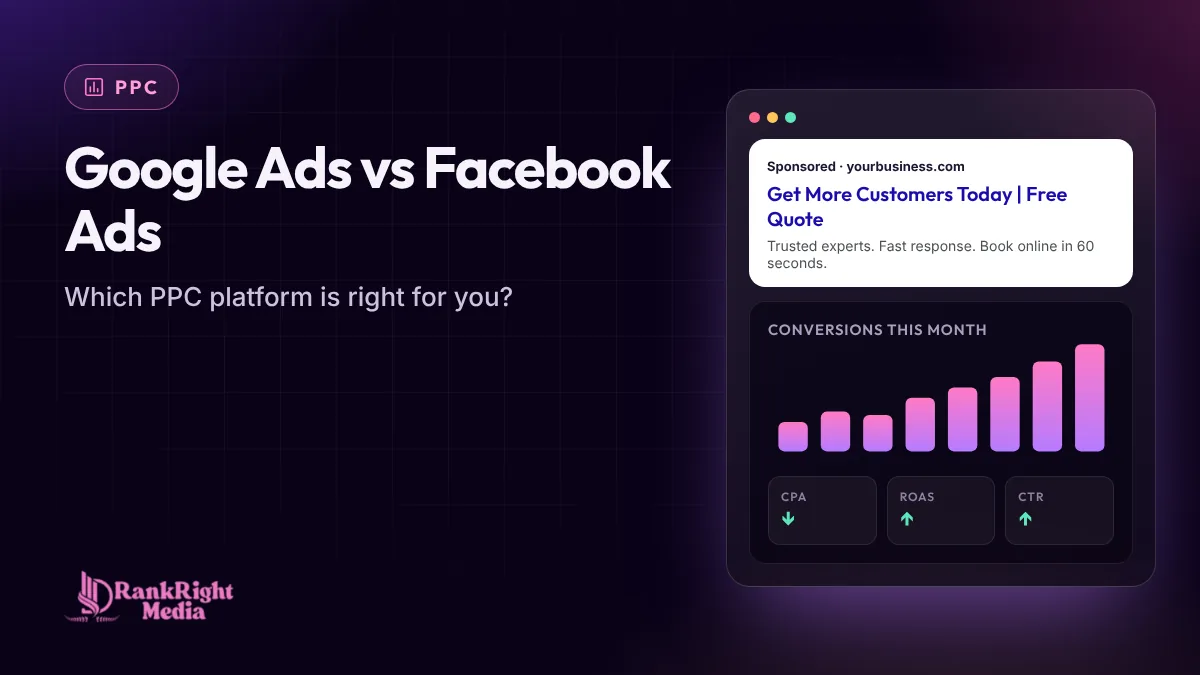
The short version: Google Ads is usually better when people are already searching for what you sell, while Facebook and Instagram ads are better for creating demand and reaching people before they search. The right choice depends on your product, your buyers and your budget — and for many businesses the answer is both.
Google Ads vs Facebook Ads at a glance
| Google Ads | Facebook & Instagram Ads | |
|---|---|---|
| How you reach people | Keywords people search for | Interests, behaviours, lookalikes, retargeting |
| User intent | High — actively looking | Lower — browsing, discovering |
| Best for | Services, urgent needs, high-intent products | Visual products, new offers, brand awareness |
| Creative | Text ads, Shopping, video, Performance Max | Images, video, carousels, Reels |
| Typical CPC | Higher | Lower |
| Conversion rate | Usually higher | Usually lower, improves with retargeting |
When Google Ads wins
- Your customers search with clear intent (“emergency electrician”, “accountant near me”).
- You sell a product people already know they want and compare on price.
- You need leads quickly and can measure enquiries or sales accurately.
When Facebook and Instagram ads win
- Your product is visual, new or impulse-friendly.
- You can define your audience by interests, life events or demographics.
- You want to build awareness, an audience or an email list.
- You need to retarget website visitors who didn’t buy.
Measure the right metric
Cost per click is misleading. A $6 Google click that converts at 8% can be far cheaper per customer than a $1 social click that converts at 0.5%. Set up conversion tracking properly — GA4 plus the Google tag and Meta Pixel — and compare cost per lead, cost per sale and return on ad spend.
The best of both: a combined funnel
- Search ads capture people ready to buy now.
- Social ads introduce your brand to new audiences.
- Retargeting on both platforms brings back visitors who didn’t convert.
- Landing pages matched to each ad lift conversion rates across the board.
Want both platforms managed together? Our Growth PPC package runs Google and Meta ads with A/B testing and bi-weekly optimisation. Not sure where your budget is going? Start with a $99 PPC Audit.
Common PPC mistakes to avoid
- Running ads before conversion tracking works.
- Broad keywords with no negative keyword list.
- Sending all traffic to the homepage instead of a focused landing page.
- Judging campaigns after a few days instead of a few weeks of data.
Conclusion
If people already search for what you sell, start with Google Ads. If you need to create demand or sell visually, start with Meta. Once one channel is profitable, add the other for reach and retargeting. Our PPC management team can help you decide and run both.
Frequently asked questions
Which is cheaper, Google Ads or Facebook Ads?
Facebook often has lower cost per click, but Google search clicks usually convert at a higher rate because of intent. Compare cost per lead or cost per sale instead.
How much budget do I need to start PPC?
Enough to gather meaningful data — often a few hundred dollars per month per platform for small local campaigns, more in competitive industries. Start controlled and scale what converts.
Can I run both platforms together?
Yes, and it’s often the most effective approach: search captures demand, social builds awareness and retargets visitors who didn’t convert.
Zain Ul Abdeen
Founder of SEO Booster UK with 10+ years of experience in SEO, website development and eCommerce strategy. Helping businesses grow online with data-driven, results-focused solutions.
Meet the team