SEO Content Writing: How to Write Content That Ranks (and Gets Cited by AI)
A practical framework for SEO content writing in 2026: search intent, structure, E-E-A-T, internal links and the formatting that helps both Google and AI assistants quote you.
 Zain Ul AbdeenFounder, RankRight Media · · Updated · 3 min read
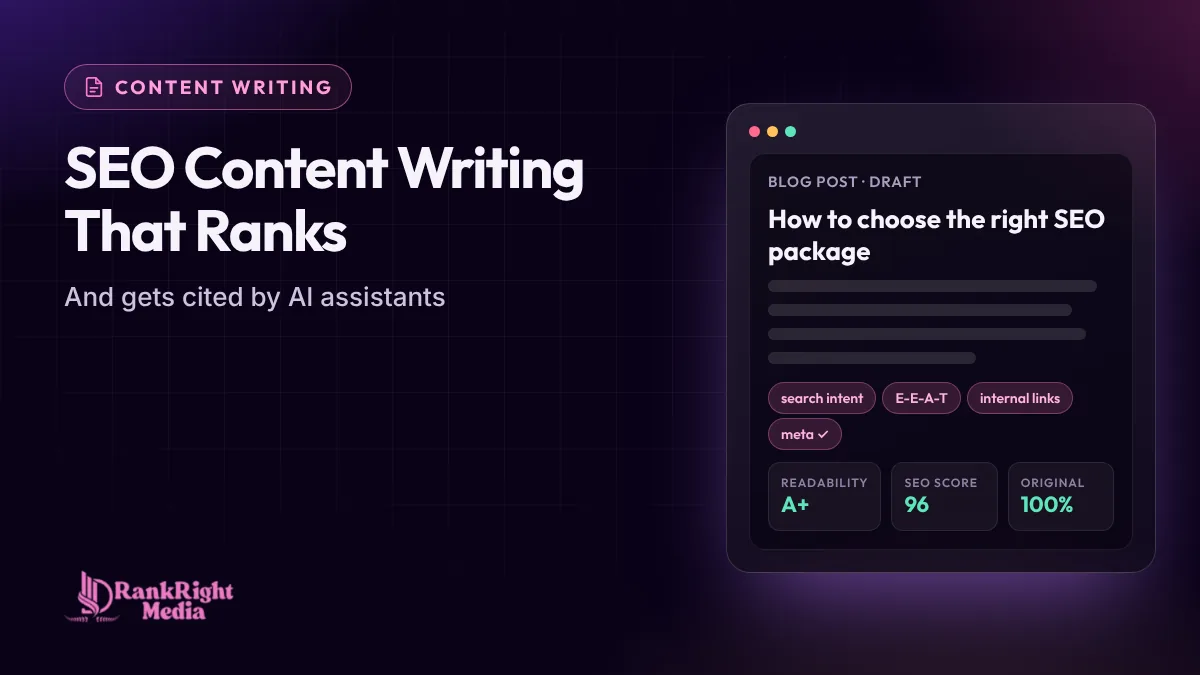
SEO content writing is creating content that answers what people search for, in a way search engines can understand and readers trust enough to act on. In 2026 it has a second job: being clear and well-structured enough that AI assistants like Google’s AI Overviews and ChatGPT quote it. The good news is that the same principles win on both fronts.
1. Start with search intent
Before writing a word, search your target keyword and study the results. Are they guides, lists, product pages or local results? That’s Google telling you what searchers want. Match the format, then beat it on depth, clarity and usefulness.
- Informational: “what is link building” → a clear explainer.
- Commercial: “best SEO packages” → comparisons and pricing.
- Transactional: “buy SEO audit” → a service or product page.
- Local: “web designer near me” → location pages and a strong Google Business Profile.
2. Answer first, then expand
Put the direct answer in the first two sentences — a definition, a number or a recommendation. Readers stay, Google can lift it for a featured snippet, and AI tools can quote it accurately. Then use the rest of the page to explain, prove and add nuance.
3. Structure for skimmers (and machines)
- Descriptive H2s that read like the questions people ask.
- Short paragraphs, bullet lists and numbered steps.
- Tables for comparisons and prices.
- An FAQ section for related questions.
- A “key takeaways” box near the top of long guides.
4. Show E-E-A-T: experience, expertise, authority, trust
Google’s guidance on helpful, people-first content rewards content written by people who know the subject. Add first-hand examples, original screenshots or data, a named author with a real bio, and accurate sources. Keep facts up to date and show when the page was last reviewed.
5. Optimise without stuffing
- Use the primary keyword naturally in the title, H1, first paragraph and URL.
- Cover the related subtopics and entities competitors mention — that’s semantic relevance.
- Write a compelling meta title (≈60 characters) and description (≈155 characters).
- Add descriptive image alt text.
6. Link internally with intent
Every new article should link to the service or product it supports, and older related posts should link back to it. Internal links spread authority and guide readers toward conversion — for example, this guide links to our SEO content writing service.
7. Update content on a schedule
Rankings decay as information ages and competitors improve. Review your top pages every 6–12 months: refresh facts, add new questions and tighten the introduction.
Need content that ranks without writing it yourself? Our Standard Plan rewrites 3–4 core pages with SEO optimisation and internal linking, from $149. See content packages →
A simple SEO content checklist
- Intent and format match the current top results.
- The main question is answered in the first two sentences.
- Headings cover the full topic and related questions.
- Real experience, examples or data are included.
- The author is named, with relevant expertise.
- Meta title, description and alt text are written.
- It links to and from relevant pages.
Conclusion
Great SEO content is simply great content that’s easy to find and easy to understand. Write for the person searching, structure it so they — and the machines — can find answers fast, and keep it current.
Frequently asked questions
How long should an SEO article be?
As long as it needs to be to fully answer the query — no longer. Check the top-ranking pages for a guide, then aim to be more useful, not just longer.
Should I use AI to write SEO content?
AI can help with research and outlines, but publishing unedited AI text rarely ranks well or builds trust. Human expertise, editing and original insight are what make content stand out.
How many keywords should one page target?
One primary topic per page, supported by closely related phrases and questions. Separate intents deserve separate pages.
Zain Ul Abdeen
Founder of SEO Booster UK with 10+ years of experience in SEO, website development and eCommerce strategy. Helping businesses grow online with data-driven, results-focused solutions.
Meet the team