What Is Link Building? A Safe, White-Hat Guide for 2026
Link building is earning links from other websites to yours. Here’s why backlinks still matter, which links help (and which hurt), and how to build them safely.
 Zain Ul AbdeenFounder, RankRight Media · · Updated · 3 min read
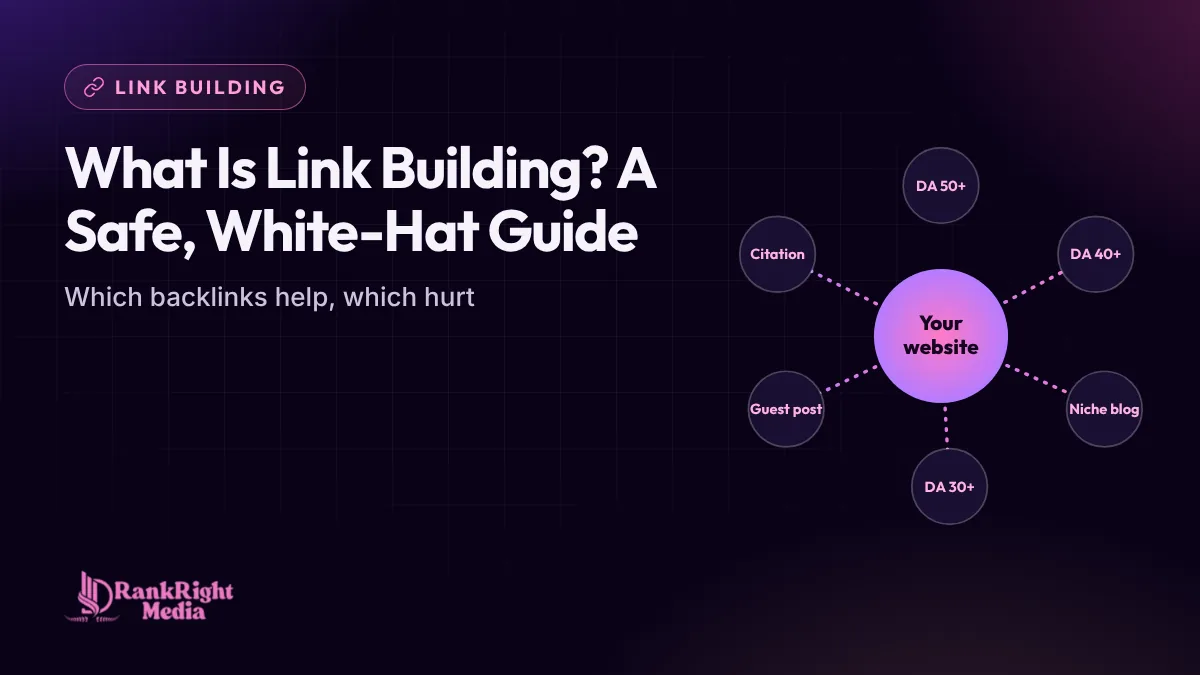
Link building is the process of getting other websites to link to yours. Search engines treat each relevant link as a vote of confidence: the more trusted sites that reference your content, the more authoritative your site appears. In 2026, backlinks remain one of the strongest ranking factors — but how you get them matters more than ever.
Why backlinks matter for SEO
Google’s original breakthrough was using links to judge which pages deserve to rank. That principle still holds. Links help search engines discover your pages, understand what they’re about from the surrounding context and anchor text, and decide how much to trust them. In competitive niches, content alone rarely wins without authority behind it.
What makes a good backlink?
| Factor | Good link | Bad link |
|---|---|---|
| Relevance | Site in your industry or a closely related topic | Unrelated site (casino link on a bakery blog) |
| Authority | Established site with real organic traffic | New or expired domain with no visitors |
| Placement | Contextual link inside useful content | Footer, sidebar or a page full of links |
| Anchor text | Natural, varied wording | Exact-match keyword stuffing |
| Source | Earned via outreach, PR or great content | Bought in bulk from a link network |
White-hat link building methods that work
Guest posting on relevant sites
Writing genuinely useful articles for respected blogs and publications in your niche, with a natural link back to a relevant page on your site.
Broken link building
Finding broken links on relevant sites and suggesting your content as a replacement. It helps the site owner and earns you a contextual link.
Digital PR and linkable assets
Original data, tools, guides and expert commentary that journalists and bloggers want to cite.
Business citations and profiles
Accurate listings on trusted directories and industry platforms. They’re foundational rather than powerful, but they build a natural profile and support local SEO.
Competitor link analysis
Studying which sites link to your competitors reveals proven opportunities for your own outreach.
Link building tactics to avoid
- Buying hundreds of links from “packages” that never name the sites.
- Private blog networks (PBNs) and link farms.
- Automated comment, forum or profile spam.
- Large-scale link exchanges and exact-match anchor text everywhere.
Google’s spam policies specifically call out link schemes. They’re not worth the risk.
How we approach link building
Every link in our link building service is placed through manual outreach on real, niche-relevant websites, and every order includes a report with live URLs. Packages range from a low-risk Basic Plan to test the waters, up to the Elite Plan with editorial links from DA 50+ websites.
Need authority in a competitive niche? Our Pro Authority package delivers backlinks from high-traffic DA 40+ sites with a 700-word premium article. Compare link packages →
Conclusion
Link building works when it mirrors how the web naturally works: relevant sites referencing genuinely useful pages. Focus on relevance, real traffic and natural placements, avoid shortcuts, and your authority — and rankings — will compound over time.
Frequently asked questions
Is link building still important in 2026?
Yes. Links remain a core way search engines measure authority. What has changed is that low-quality, manipulative links are ignored or penalised, so quality matters more than ever.
How many backlinks do I need?
There’s no fixed number. Compare the referring domains of the pages ranking above you for your target keyword; that’s your realistic benchmark.
What is a dofollow link?
A normal link that passes ranking signals. Links marked rel="nofollow", "sponsored" or "ugc" are hints to Google not to pass full credit.
Can bad backlinks hurt my site?
Google mostly ignores spammy links, but large-scale manipulative link building can lead to a manual action. If you have a history of paid spam links, an audit is worthwhile.
Zain Ul Abdeen
Founder of SEO Booster UK with 10+ years of experience in SEO, website development and eCommerce strategy. Helping businesses grow online with data-driven, results-focused solutions.
Meet the team